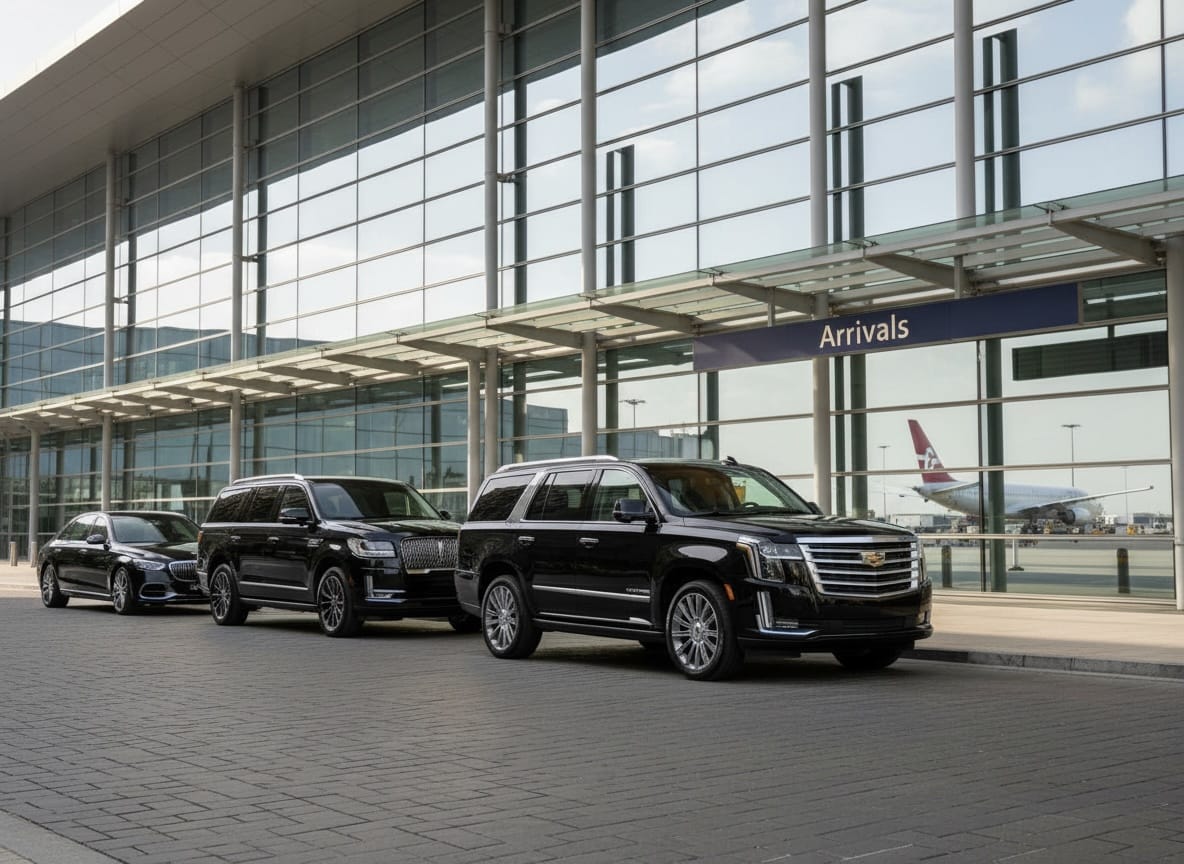
Airport delays are nothing new. What has changed is how often those delays ripple into ground transportation failures.
For many travelers, the most unpredictable part of flying now begins after landing. Missed pickups, curbside congestion, and transportation that fails to adapt to real-world conditions have exposed a growing reliability gap between air travel and ground operations.
Increasingly, that gap is being addressed not by adding more vehicles or staff—but by artificial intelligence working quietly behind the scenes. As broader transportation systems evolve, AI is already reshaping how mobility networks anticipate demand, manage congestion, and reduce friction across complex environments, a trend explored in depth by Forbes in its analysis of how AI is driving the future of transportation.
The Problem with Static Airport Pickups
Traditional airport pickup models are built on fixed assumptions:
-
Flights arrive close to schedule
-
Passengers exit terminals within predictable windows
-
Drivers can be dispatched using static timing
In practice, arrival readiness is affected by far more variables—weather, gate availability, air traffic control, customs processing, and airport congestion among them.
When ground transportation systems rely on static schedules, even small disruptions can create cascading failures: drivers arrive too early or too late, curbside space becomes congested, and passengers are left waiting precisely when reliability matters most.
AI as an Operational Layer, Not a Feature
In modern ground transportation systems, AI is not a visible feature. It functions as an operational layer.
By analyzing:
-
Live flight status data
-
Historical delay patterns
-
Real-time traffic conditions
-
Airport congestion trends
AI-driven dispatch systems continuously recalibrate pickup timing and vehicle positioning. Instead of reacting after a delay is confirmed, these systems anticipate disruption and adjust before passengers are affected.
This approach aligns with how AI is increasingly being used to improve traffic flow, reduce congestion, and enhance roadway safety across California. Recent reporting by the Los Angeles Times highlights how generative AI is being explored to make California roads safer and more responsive.
Reliability Over Speed
As airport congestion increases, speed alone no longer defines a successful pickup. Reliability does.
For business travelers, executives, and international arrivals, the cost of a missed or delayed pickup extends beyond inconvenience. It disrupts schedules, undermines confidence, and affects first impressions.
As a result, reliability—defined by accurate timing, adaptability, and coordination—is becoming the primary metric by which airport transportation is evaluated.
Applying AI in Real-World Operations
Some TCP-licensed ground transportation providers in Southern California, including Emelx, have integrated AI-assisted flight tracking and predictive dispatch systems to align chauffeur arrivals with actual flight conditions rather than published schedules.
This approach emphasizes:
-
Anticipation over reaction
-
Coordination over rigid timing
-
Consistency across multiple airports and traffic environments
While largely invisible to passengers, these systems significantly reduce wait times and curbside friction during delays.
A Quiet Transformation
AI is not eliminating airport delays. What it is doing is reducing their downstream impact.
As airports grow busier and travel patterns more complex, pickup reliability will increasingly depend on systems that adapt intelligently to disruption. The transformation is quiet, incremental, and largely unseen—but it is redefining what travelers expect when they land.